Pricing Your Work–What Your Hourly Rate Really Means (And Why Most Dentists Get It Wrong)
Dr. House reveals ethical pricing strategies that protect your team, serve patients well, and create sustainable dental practice success.
Nov 11, 2025

Beyond Insurance Dictates: A Comprehensive Guide to Authentic Dental Practice Pricing
How to Price Your Services with Confidence, Sustain Your Team, and Build a Practice Aligned with Your Values
For many dentists, especially those building an authentic dental practice from scratch or transitioning to a more values-aligned model, pricing remains one of the profession's most uncomfortable conversations. Unlike many creative industries where pricing can fluctuate dramatically based on perceived value, dentistry operates within a complex ecosystem of insurance reimbursements, competitive pressures, and the fundamental challenge of communicating value for something patients often don't fully understand.
In a recent episode of The Authentic Dentist Podcast, Dr. Allison House—a practicing dentist with over 25 years of experience—and Shawn Zajas, a dental marketing expert, explored the often-overlooked intersection of dental practice profitability ethics and authentic leadership. Their conversation reveals that pricing your services isn't just about covering overhead; it's about creating a sustainable dental practice model that honors your team, serves your patients with integrity, and prevents the burnout that plagues the profession.
The Insurance Company Dilemma: Reclaiming Your Pricing Power
"The disappointing thing, I think, as a dentist is that someone prices them for you when you first start your practice or you're working for somebody," Dr. House observes. "The insurance company has basically given you what they're going to pay you. And so you don't have as much control."
This reality represents one of the most significant challenges in overcoming dental practice challenges in today's healthcare landscape. Insurance reimbursements create an artificial ceiling that many practitioners accept without question, losing sight of a fundamental truth: you do have control over your fees.
For dentists seeking a dental fee-for-service transition or simply wanting to price services appropriately within an insurance-based model, understanding your true costs becomes essential. This isn't about maximizing profit at patients' expense—it's about creating a framework for sustainable dental practice success that allows you to deliver excellent care without sacrificing your financial viability or your team's wellbeing.
The Pankey Institute Framework: Your Hourly Rate as Foundation
Dr. House credits Dr. Gary DeWood at the Pankey Institute with teaching her a data-driven approach to pricing that forms the bedrock of her practice's financial health. The framework begins with a deceptively simple question: What is your practice's true hourly rate?
"You base it on data and the data is your hourly rate," Dr. House explains. Here's how to calculate it:
Step 1: Gather Your Annual Data
Total amount collected for the entire year
Total hours worked by you (the dentist) during that year
Step 2: Calculate Your Base Hourly Rate
Divide total collections by total hours worked
This gives you your current hourly rate for the practice
Step 3: Factor in Your Desired Compensation
Calculate all practice expenses
Determine the salary you need to pay yourself (not just what's left over)
Adjust your hourly rate upward to ensure both expenses and your salary are covered
As Dr. House notes: "A lot of times you get paid last, and that's because you didn't account for your salary in those fees."
This approach to dental practice core values ensures that pricing decisions flow from data rather than guesswork, fear, or false humility. It's a framework that supports finding fulfillment as a dentist by removing the resentment that builds when you're consistently undercompensated for your time and expertise.
Beyond the Hourly Rate: The Complete Pricing Picture
While the hourly rate provides essential foundation, authentic dental practice pricing requires considering additional factors:
Material and Lab Costs Every procedure carries associated costs beyond your time. Crowns require lab work. Implants involve multiple components. Cosmetic cases may demand custom shade matching. Dr. House emphasizes building these costs directly into your pricing: "You've got material cost, you've got the actual cost of the crown. So you've gotta factor those kind of things too."
Complexity and Skill Requirements A crown on a back tooth differs significantly from a front tooth cosmetic restoration. The latter requires additional time, custom shade work, and higher stakes for aesthetic outcomes. Dr. House charges patients directly for some complexity costs: "I just have you pay the lab so I don't have to be part of that."
Your Learning and Lab Time If a complex case requires you to spend four hours in the lab creating a wax-up, that time deserves compensation. Your hourly rate applies to all professional time spent on patient care, whether clinical or preparatory.
The Three Pricing Lessons That Transform Practices
Lesson One: The Psychology of Perceived Value
Dr. House shares a transformative insight from early in her practice: "The tube of bleach was $30. It took me like a hundred dollars to make the molds for you. $130, maybe $150, patients will not do it."
Initially pricing bleaching at $150—barely covering costs—she discovered patients didn't value the treatment and wouldn't complete it. Complaints rolled in about it "not working" because patients simply didn't use what they'd purchased.
The solution? She raised the price to $600 and packaged it in an elegant presentation. "They think that's valuable. Now I put it in a nice pretty Tiffany box and they will go home and do it. And it works because they did it."
This principle extends far beyond bleach trays. When we underprice our services, we inadvertently signal that they lack value. Patients who don't perceive value won't commit to treatment, won't follow through with care instructions, and won't achieve the outcomes that transform their lives. Authentic dental marketing means pricing in a way that communicates the true value of transformation you're offering.
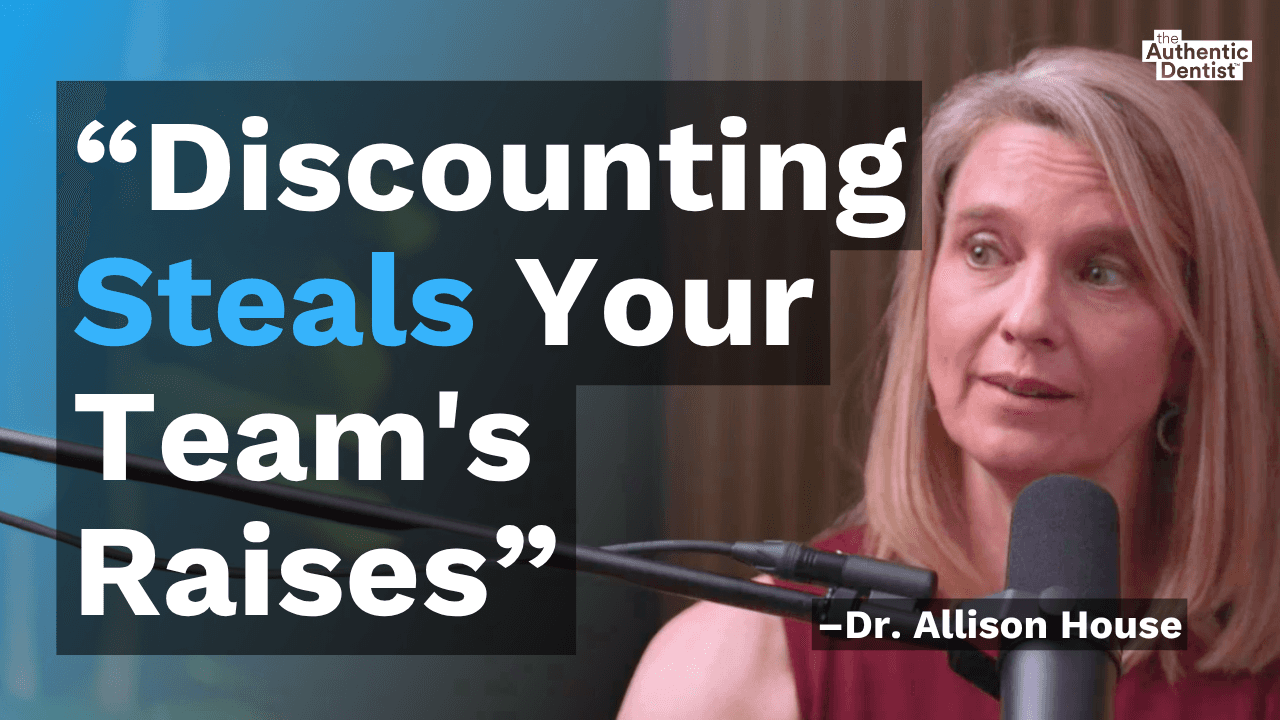
Lesson Two: Discounting Steals From Your Team
Perhaps the most powerful moment in the conversation came when Dr. House shared her office manager's blunt assessment of her discounting habit: "You are giving away our raises."
This insight cuts to the heart of dental practice profitability ethics. When you discount your services out of sympathy or discomfort with pricing, you're not just reducing your income—you're taking money that should fund team bonuses, competitive salaries, better equipment, and continuing education that elevates everyone's performance.
Dr. House's solution demonstrates authentic leadership: "My decision has always been that I charge what I charge. This is the minimum... I do, however, decide that I'm gonna do so much, like $15,000 worth of free work every year, and so I get to decide whoever I want to."
By budgeting for charity care rather than haphazard discounting, she can be generous while protecting her team's compensation and the practice's sustainability. It's a model that aligns business necessities with ethical practice—one of the core tensions addressed throughout The Authentic Dentist Podcast.
Lesson Three: The Danger of Overpricing Your Current Skill Level
In 2012, Dr. House moved into "a really fancy office" and raised her veneer pricing significantly—perhaps prematurely. "I charged a lot more for a veneer, probably what I'm charging now, but I didn't have as much skill as I do now."
The result? She attracted highly demanding patients with expectations she couldn't consistently meet. "I didn't have the ability to say, we can't do that. That's not gonna happen. Your bone structure doesn't like that. And so I would just do it and then they would be unhappy."
This lesson reveals a nuanced truth about pricing as part of your dental practice branding strategies: Your fees signal the level of expertise and outcomes patients should expect. Price too high before you've developed the clinical mastery to deliver consistently, and you create disappointment for patients and stress for yourself.
"If you're charging a lot of money, you're attracting a certain clientele, they have certain demands and you can't meet them, then you're just uncomfortable too," Dr. House reflects. "And you've made everybody unhappy, including yourself."
The solution? Invest in continuing education, build your skills, and let your pricing grow in alignment with your capabilities. This creates a sustainable dental practice model where you can deliver on promises and sleep well at night.
The Antitrust Reality: Why Dentists Can't Just "Check the Market"
One surprising revelation in the conversation: Dentists legally cannot discuss their fees with other local practitioners. "You're not allowed to talk about money amongst each other," Dr. House explains. "That is still an antitrust violation."
This restriction exists to prevent price-fixing, but it also means you can't simply call colleagues in your area to determine appropriate pricing. You must develop your pricing strategy through data, education, market research of publicly available information, and consultation with practice management experts or dental practice coaching resources.
Regional differences matter enormously—what makes sense in Alabama differs vastly from New York—but these differences flow from cost of living, staff wages, and overhead rather than arbitrary market positioning.
Education as Value Creation
A critical insight emerges about communicating value to patients: education transforms perception. When Dr. House presents treatment options, she doesn't just quote prices—she explains the process, the materials, the time involved, and most importantly, the outcomes for the patient's life.
"You are creating that value," Shawn observes, "and it's worth a lot to be able to eat those foods."
Dr. House agrees: "For some patients that's not true. They don't care. And that's fine. It's what's important to them, but it's not about you... None of this is about me. I present all the options. You pick whatever you want."
This approach embodies authentic dental practice principles: honoring patient autonomy, communicating clearly about choices, and trusting patients to make decisions aligned with their values and priorities. It's the opposite of high-pressure sales tactics or trying to manufacture urgency through manipulation.
The Hygiene Economics Reality Check
Dr. House also addresses a painful but necessary calculation: understanding your hygiene department's economics. "I calculate how much we're collecting for hygiene, how many hygiene hours we had, and then I kind of have an idea of what I'm paying my hygienist too."
This analysis once revealed she was losing money with a particular insurance on hygiene. "I can't collect less per hour than I'm paying out. That wasn't reasonable."
The decision to drop that insurance wasn't about maximizing profit—it was about creating a sustainable model. This type of difficult decision exemplifies the ethical dilemmas practitioners face when insurance reimbursements don't cover actual costs. It's part of redefining success in dentistry: sometimes doing what's right for your practice's survival means making choices that feel uncomfortable.
Context Matters: The Lamborghini Principle
Shawn shares a fascinating insight from a recent conference about the psychology of pricing: the same dollar amount can seem absurdly cheap, perfectly reasonable, or obviously fraudulent depending on context. $300 for a trivial item seems ridiculous. $300 for something typically $600 seems like a great deal. $300 for a Lamborghini signals an obvious scam.
"It's the same exact number. But depending on the context, you either think it's crazy or you think it's a great deal," Shawn explains.
For dentists, this means patient education about context becomes crucial. Most patients have no framework for understanding what comprehensive dental care should cost. They may have arbitrary expectations based on limited information or outdated experiences.
Creating context through education—explaining the materials, the time involved, the skill required, the transformation delivered—helps patients understand whether your pricing represents fair value. It's not about justifying high fees; it's about providing the information needed for informed decisions.
Alignment: The Path to Sustainable Success
Throughout the conversation, a theme emerges that defines The Authentic Dentist Podcast's approach: alignment. Prices must align with:
Your overhead and expenses - ensuring practice sustainability
Your team's fair compensation - preventing the theft of raises through excessive discounting
Your current skill level - avoiding the stress of overpromising
Your patients' understanding - through education that creates appropriate context
Your values - including planned charity care that honors your desire to serve
This multi-dimensional alignment represents what authentic dental practice actually means: not just being true to yourself, but creating systems and structures that allow your values, your business realities, and your patient care to coexist harmoniously.
Moving Forward: Action Steps for Authentic Pricing
If you're working toward a more sustainable and authentic pricing model, consider these steps:
1. Calculate Your True Hourly Rate Follow Dr. House's framework: total collections divided by total hours worked, then adjusted for appropriate owner compensation and expenses.
2. Audit Your Procedures Apply your hourly rate to each procedure based on time required. Factor in material costs, lab fees, and any additional complexity.
3. Identify Underpriced Services Look for procedures where you're losing money or not covering true costs. The bleach example might reveal other undervalued treatments.
4. Evaluate Your Skill-Price Alignment Are you charging fees that demand clinical outcomes you're still developing? Consider whether additional training might be needed before raising fees, or whether your fees should increase to match expertise you've already developed.
5. Review Insurance Relationships Calculate whether insurance contracts are covering your actual costs, especially in hygiene. Some relationships may need to be renegotiated or ended.
6. Create an Education Framework Develop clear ways to communicate value, process, and outcomes so patients have appropriate context for pricing.
7. Budget for Charity Care Rather than ad hoc discounting, plan for a specific amount of free or reduced-cost care annually, protecting both your generosity and your team's compensation.
The Bigger Picture: Pricing as Self-Respect
Near the conversation's end, Dr. House offers this reflection: "I feel like that's really helpful. Let's also say then, let's say a crown... But then you also have some overhead there too that you've gotta account for like more material cost."
The attention to detail in her pricing reflects something deeper than mere business acumen. It represents self-respect—the conviction that your time, skill, and the transformation you provide deserve fair compensation. It represents team respect—ensuring those who work alongside you can build sustainable careers. And it represents patient respect—trusting them with honest information about costs and value rather than manipulating through artificial scarcity or discounting.
This is what dental practice work-life balance actually requires: pricing that allows you to work reasonable hours, pay your team well, invest in continuing education, and still make the income that makes dentistry a viable career choice. It's what prevents dentist burnout—knowing that every hour you work is valued appropriately and contributes to a sustainable future rather than a grinding present.
Conclusion: Data-Driven Authenticity
The conversation between Dr. House and Shawn Zajas reveals that pricing in an authentic dental practice isn't about abandoning data for intuition, or sacrificing profitability for ethics. Instead, it's about using data to make ethical decisions, creating frameworks that honor all stakeholders, and building the courage to charge what your services are actually worth.
As Dr. House summarizes: "You just have to make sure that you're not losing money per hour. I think that's the big thing... and that you're paying attention to your expenses too."
It sounds simple, but beneath that simplicity lies a profound shift: moving from pricing based on fear, comparison, or insurance company dictates to pricing based on your authentic cost structure, skill level, and values.
This is the path to finding fulfillment as a dentist—building a practice where the economics support rather than undermine your calling, where your team thrives alongside you, and where patients receive care that transforms their lives while understanding and appreciating its true value.
Want to dive deeper into building an authentic dental practice aligned with your values? Subscribe to The Authentic Dentist Podcast for candid conversations about the real challenges facing modern dentists—and the wisdom to navigate them with integrity.
Tags
practice-management, profitability, ethics, team-building, sustainable-success, practice-owners, values-alignment, confidence